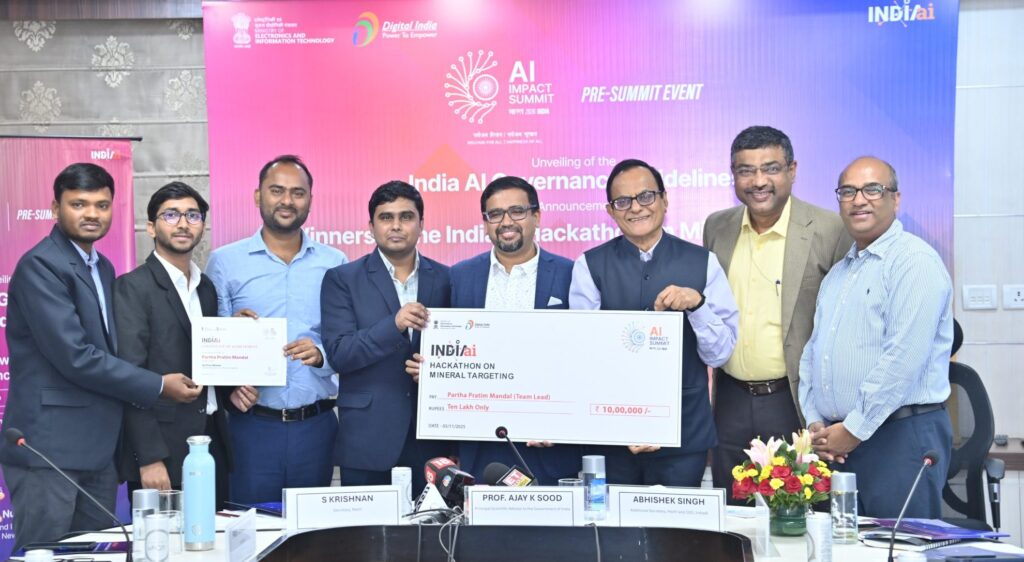
In a significant leap for India’s technological roadmap, the Ministry of Electronics & Information Technology (MeitY), through the IndiaAI Mission, has formally unveiled its AI Governance Guidelines. These set out a comprehensive framework to guide the country’s ambitious journey in artificial intelligence — one that is safe, inclusive, responsible and aligned with human-centred values.
With this release, India signals its intent to not just embrace AI, but to govern it thoughtfully, mitigating risks while catalyzing innovation.
What the Guidelines Cover (IndiaAI Mission):-
- Guiding Principles – “Sutras” for Ethical AI- The framework introduces seven guiding principles (or “Sutras”) that anchor the AI ecosystem in India. These principles emphasis human-centricity, transparency, fairness, accountability and a strong risk-mitigation ethos.
- Six Governance Pillars- The guidelines structure AI governance around six core pillars—ranging from policy and regulations, to standards, capacity building, innovation enablement, data and infrastructure, and monitoring & assurance. The idea: a holistic ecosystem, not piecemeal.
- Action Plan: Short, Medium & Long Term-Recognizing that AI evolves quickly, the document lays out an action matrix matched to short-term (immediate), medium-term and long-term timelines. This helps ensure adaptability and timely implementation rather than static lab regulation.
- Practical Guidelines for Industry, Developers & Regulators-Rather than mere high-level aspirations, the framework includes actionable guidance for industry players, developers, regulators. This includes innovation sandboxes, risk assessment protocols, transparency mandates and mechanisms for stakeholder engagement.
What Makes This Milestone Important:-
- Human-Centricity and “Do No Harm”- One of the standout elements is the explicit commitment to “Do No Harm” embedded in the framework. As noted by the country’s Principal Scientific Adviser, this is meant to ensure that AI serves people, rather than people serving technology.
- Balancing Innovation & Regulation-Rather than stifling innovation with heavy handed rules, the framework emphasizes innovation sandboxes— controlled, flexible environments where new AI solutions can be tested without the full burden of regulation, but with safety nets.
- Leadership on Global Stage:-By creating such guidelines, India positions itself as a thought-leader in the Global South when it comes to AI governance. The guidelines are built to enable national and international cooperation for safe AI deployment.
- Sector-Inclusive Approach:-The guidelines are not limited to one industry or sector. They aim for cross-sectoral deployment—from mining and minerals (as illustrated by the hackathon winners) to broader applications—ensuring that AI’s benefits are widely distributed.
What Next? Implementation & Impact
- Hackathon Successes Signal Real-World Use:-At the launch event, winners of the IndiaAI Hackathon (in collaboration with the Geological Survey of India for mineral-targeting) were announced—highlighting how AI is being applied already in sectors like critical minerals, exploration, semi-supervised learning for resource mapping.
- Preparing for the India-AI Impact Summit 2026:-These guidelines also set the stage for the upcoming India–AI Impact Summit 2026 (19-20 Feb 2026, New Delhi), which is expected to bring together global policymakers, industry leaders and researchers to chart the next frontier of AI for people and planet.
-
Role for Startups, Industry & Academia:-Startups and AI developers will need to align with these guidelines—especially around responsible deployment, transparency and risk-mitigation. Regulators and academia will be involved in capacity building and oversight.
Challenges to Watch:-
-
Ensuring that guidelines translate into on-ground practice (not just paper).
-
Maintaining a balance between innovation pace and regulatory safeguards
-
Enabling smaller players (startups, MSMEs) to comply without burden
-
Monitoring evolving risks (bias, privacy, job displacement) as AI maturity grows.
Why This Matters for India & Beyond:-
For India: as the country pushes to capture the “AI dividend”, having a credible governance framework strengthens investor confidence, fosters responsible innovation, and helps avoid pitfalls of hasty deployment.
For society: the human-centric emphasis means that AI is meant to serve communities, be inclusive, reduce harm, rather than just drive profits or automation at cost of jobs or rights.
For global ecosystems: India’s guidelines may serve as a model especially for other developing nations seeking to harness AI safely—therefore boosting India’s soft-power and leadership role.
Conclusion:-
The unveiling of India’s AI Governance Guidelines under the IndiaAI Mission is more than a policy announcement—it’s a statement of intent. By marrying innovation with responsibility, by putting humans at the heart of AI, and by creating flexible yet robust frameworks, India is laying a foundation for the next era of digital growth. Stakeholders—developers, industry, regulators, citizens—will now need to engage actively to bring this vision to life. As the pace of AI accelerates globally, India’s approach may well become a template for safe, inclusive, future-ready AI ecosystems.