Introduction
Digital payments have transformed the way people manage money. Whether paying a utility bill, buying groceries, or sending money to family members, consumers increasingly expect transactions to happen instantly. India has been one of the world’s leaders in this transformation through the Unified Payments Interface (UPI), a platform that has changed everyday banking for millions of users.
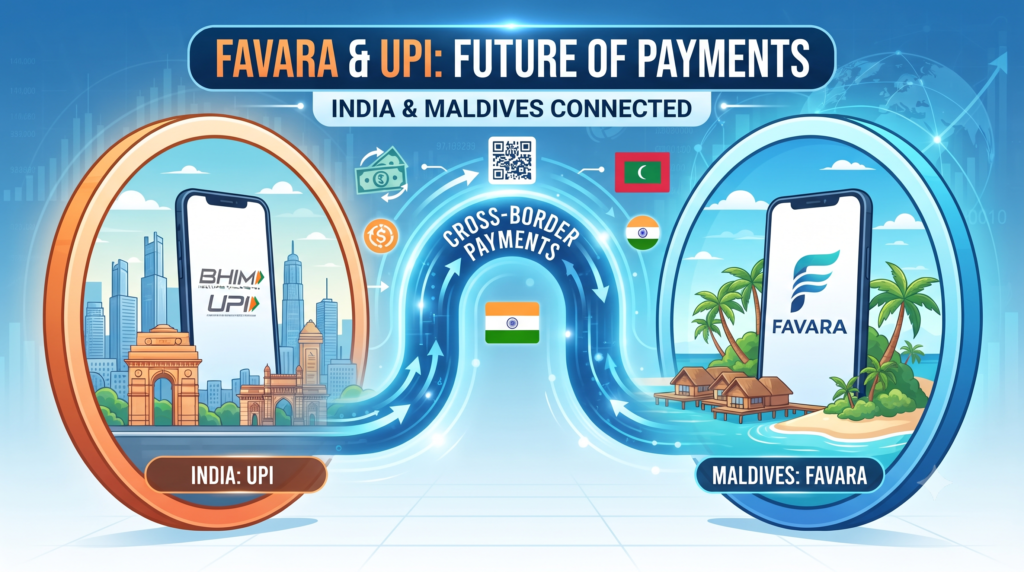
A new milestone has now been reached with the launch of the Favara UPI cross-border payment corridor between the Maldives and India. This integration connects the Maldives’ instant payment system, Favara, with India’s UPI network, allowing eligible users to transfer funds quickly and securely across borders.
The initiative is more than a technical upgrade. It reflects growing cooperation between two neighboring countries while making international money transfers more efficient for ordinary people.
What Is Favara?
Favara is the Maldives’ national instant payment system. It was developed to make domestic digital payments faster, safer, and more convenient.
Instead of depending on lengthy banking procedures, Favara enables customers to transfer money electronically using mobile banking applications. The platform is designed to reduce delays while encouraging the use of digital financial services throughout the country.
With its connection to India’s UPI network, Favara has now expanded beyond domestic payments into international transfers.
Understanding India’s UPI
India’s Unified Payments Interface, commonly known as UPI, is one of the most successful digital payment systems in the world.
UPI allows users to send and receive money instantly using smartphones without entering lengthy bank account details for every transaction. Individuals can transfer money at any time of the day, making banking faster and more accessible.
Since its launch, UPI has become an essential part of India’s digital economy, supporting everything from small retail purchases to business transactions.
What the New Integration Means
The Favara–UPI integration creates a direct payment bridge between India and the Maldives.
In practical terms, eligible users in the Maldives can now initiate transfers through participating banks using their mobile banking applications. The payment is processed in real time, and the recipient receives Indian Rupees directly in a UPI-enabled bank account.
The first phase focuses mainly on person-to-person remittances, including family maintenance transfers and certain permitted gift payments. Authorities have also announced plans to expand the service further in future phases.
Benefits for Individuals
Faster Money Transfers
Traditional international transfers often require multiple banking intermediaries and can take several business days.
The new payment corridor significantly reduces waiting time by allowing near real-time transfers.
Greater Convenience
Users no longer need complicated international payment procedures for eligible transfers.
Transactions can be initiated directly through participating banks’ mobile applications.
Improved Transparency
Digital payment systems provide clear transaction records, making it easier for both senders and recipients to monitor payments.
Better User Experience
With fewer processing steps, customers enjoy a smoother banking experience that matches modern expectations for instant digital services.
Economic Importance
Although India and the Maldives have maintained close economic ties for decades, digital financial connectivity introduces a new level of cooperation.
Efficient payment systems can help support:
- Tourism
- Small businesses
- Professional services
- Educational expenses
- Family remittances
- Financial inclusion
Reducing payment delays may also improve business confidence between the two countries.
Strengthening Digital Cooperation
The payment corridor demonstrates how countries can work together using modern financial technology.
Rather than replacing existing banking infrastructure, the integration connects trusted national payment systems.
This collaborative approach helps improve security while allowing both countries to maintain their own banking regulations.
The project was developed through cooperation involving the Maldives Monetary Authority, the Reserve Bank of India, NPCI International Payments Limited (NIPL), and participating financial institutions. (DD India)
Future Possibilities
Officials have indicated that the current launch represents only the beginning.
Future developments may include:
- QR code merchant payments
- Expanded digital commerce
- Additional cross-border payment services
- Wider participation from financial institutions
- Improved support for international travelers
As digital payment ecosystems continue to evolve, cross-border interoperability is expected to become increasingly important.
Why This Matters Globally
Many countries are exploring ways to modernize international payments.
Cross-border transfers have traditionally been slower and more expensive than domestic transactions. By linking instant payment systems, countries can improve efficiency while maintaining regulatory oversight.
The Favara–UPI integration represents another example of how digital public infrastructure can support international financial connectivity.
Challenges Ahead
Despite its promising start, continued success will depend on several factors.
These include:
- Expanding participating banks
- Maintaining strong cybersecurity standards
- Educating customers about the service
- Ensuring regulatory compliance
- Supporting future payment innovations
Addressing these areas will help increase adoption while maintaining public trust.
Conclusion
The launch of the Favara–UPI cross-border payment corridor marks an important step in digital financial cooperation between India and the Maldives.
By connecting two modern payment systems, the initiative offers faster transfers, greater convenience, and improved efficiency for eligible users. It also highlights the growing role of digital public infrastructure in strengthening international economic relationships.
As more payment services are added in future phases, this partnership has the potential to become an important model for cross-border digital payments in the region.
Rather than simply making transactions faster, the Favara–UPI integration demonstrates how technology can simplify financial services while bringing neighboring economies closer together.