If you’ve just finished your graduation and are looking for a great launchpad into the banking sector, here’s some excellent news. Central Bank of India Apprentice Recruitment (2026-27 )one of India’s oldest and largest public sector banks, has rolled out a massive recruitment drive for apprentices under the Apprentices Act, 1961. With a whopping 4,500 training seats up for grabs across the country, this is one of the biggest apprenticeship opportunities in the banking sector this year.
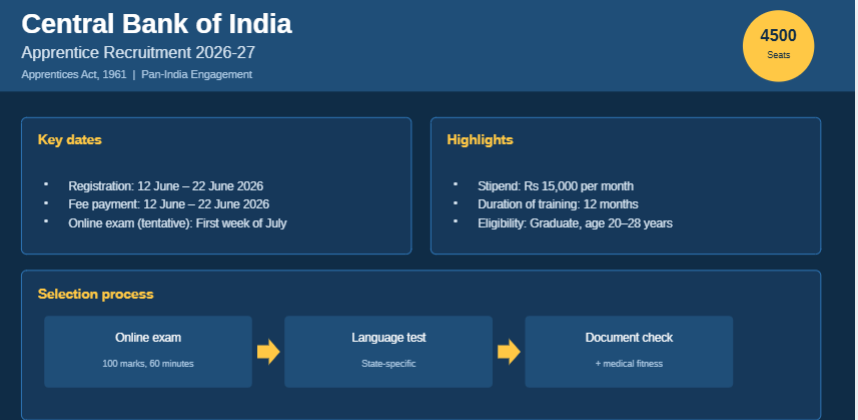
Let’s break down everything you need to know.
Central Bank of India, founded way back in 1911, holds the distinction of being the first Indian commercial bank that was entirely owned and run by Indians. Today, it operates more than 4,500 branches across the country and employs over 34,000 people, with a total business volume crossing Rs. 8,12,000 crore. Now, the bank is opening its doors to fresh graduates through this apprenticeship program.
Important Dates to Remember
| Particulars | Details |
| Total Seats | 4,500 |
| Registration Opens | June 12, 2026 |
| Registration Closes | June 22, 2026 |
| Fee Payment Window | June 12 to June 22, 2026 |
| Online Exam (Tentative) | First week of July |
Since the window for registration is fairly tight, don’t wait till the last date — server load and technical glitches are common when everyone rushes in at once.
Age Limit
Candidates must be born between May 31, 1998, and May 31, 2006. That places the age bracket between 20 and 28 years for general category applicants. Relaxations apply for reserved categories — SC/ST candidates get a 5-year relaxation, OBC (non-creamy layer) get 3 years, and PwBD candidates get relaxations ranging from 10 to 15 years depending on their category.
Educational Qualification
You need to hold a graduation degree (in any discipline) from a recognized university, completed on or after January 1, 2022.
Nationality
Indian citizens are eligible, along with certain categories of subjects from Nepal, Bhutan, and specific groups of Tibetan and other refugees as defined by the notification.
NATS Registration
This is crucial — candidates must first register themselves on the National Apprenticeship Training Scheme (NATS) portal before applying for this opportunity.
Selection Process
The selection isn’t just a single-stage process. Here’s how it works:
- Online Examination – A 100-mark objective test covering five sections: General/Financial Awareness, Quantitative & Reasoning Aptitude, Computer Knowledge, General English, and Central Bank of India’s Products & Services. You get 60 minutes, and there’s no negative marking, so attempt every question.
- Local Language Test – Since postings are state-specific, candidates need to demonstrate proficiency in the official language of the state they’re applying for. If you’ve studied that language up to 10th or 12th standard, you’re exempt from this test.
- Document Verification & Medical Fitness – Final selection depends on satisfactory verification of your documents and a medical fitness check.
Stipend and Duration
Selected apprentices will undergo training for 12 months and receive a monthly stipend of Rs. 15,000. Keep in mind that apprentices are treated as trainees, not employees — so standard labour law benefits, allowances, or job guarantees after the training period don’t apply.
Application Fees
| Category | Total Fee (incl. GST) |
| General/EWS/OBC (Male) | Rs. 944 |
| General/EWS/OBC (Female) | Rs. 708 |
| SC/ST (All) | Rs. 236 |
| PwBD (All) | Rs. 236 |
| Transgender (All) | Rs. 236 |
Payment has to be made online, and it’s strictly non-refundable.
State-Wise Highlights
Some states have particularly large allocations — Maharashtra leads with 586 seats, followed by Uttar Pradesh (580), Madhya Pradesh (459), and Bihar (433). Smaller states and union territories like Mizoram, Andaman & Nicobar Islands, and Daman & Diu have just 1 seat each, so competition there will naturally be intense relative to availability.
A Few Things Students Should Note
- You cannot have completed an apprenticeship before, either with this bank or elsewhere.
- Only one application is allowed per candidate — multiple applications lead to rejection.
- There’s no provision for transport, hostel, or accommodation during training.
- This apprenticeship doesn’t guarantee a regular job afterward, but it’s a solid way to gain hands-on banking exposure and strengthen your resume for future banking exams.
Final Word
This is a golden opportunity for fresh graduates wanting real exposure to the banking sector before appearing for competitive exams like IBPS or SBI. Given the scale of vacancies and the structured training period, it’s worth applying — just make sure you register on the NATS portal early and keep all your documents ready well in advance.